Friday, October 28, 2011

When I Think of Child Development …

The following quote sums up my belief of what all professionals that deals with children should remember in every action they take...

We worry about what a child will become tomorrow, yet we forget that he is someone today.  ~Stacia Tauscher

We must remember that they are children and they deserve to be just that too.

Thank you all for sharing this Blogging and Graduate experience with me.  I have enjoyed viewing,  reading, and exchanging your many views and have gained so much new information.  Good Luck to you all on your future journeys. : D  

Saturday, October 15, 2011

Testing for Intelligence?

I think a child’s academic abilities should be assessed, but not to size him up to every other person in his age range.  I should be used  to understand he knows and what he needs.  I personally disagree with standardized testing and how it is implicated into our schools.  Standardized scores can not accurately assess a person’s intelligence, or their ability to learn.  It only can measure what a person has learned, and as we all know not all schools are taught “Equally”.  My mother graduated high school with an ‘F’ average and her standardized scores reported her to be mentally retarded.  She is not retarded at all.  She missed most of her schooling because she was a sharecropper’s child, which meant she spent most of able time in the fields.  My mother knew her only way out was to go to college.  So she intelligently pleaded her case the Dean of a locale University to allow her in and he did so.  She not only earned her B.A., but she also earned  a master’s degree in psychology.  

Standardized Testing has made its way to Russia
According to a recent article by Kevin O’Flynn students and teachers are outraged with the new standardized testing called Unified State Exam.  The articles states, “The Russian Education Ministry says it is introducing the EGE as part of its obligations as a member of the Council of Europe under the Bologna convention on higher education” (O’Flynn, 2011).  Does any of this sound familiar?  They are having the very same battle that the US is having with its Ridiculous No Child Left Behind.

Friday, September 30, 2011

Consequences of Stress on Children’s Development

My biggest stressor as a child was suffering from social anxiety.  I believe I developed this because my family moved so much and I changed schools every year until I reached the 9th grade.  When you are already shy, constantly being forced into strange places with strange people is too much.  At least for me it was.  I never really learned how to create long lasting friendships.  By high school I was completely socially stunned.  I did not participate in class or with activities for fear of rejection and not being accepted.  I lived life strictly alone in my room and through TV.  As a result in my adult life I continued to move all the time out of habit and searching for a place to belong.  I slowly learned the skill of small talk and engaging with others in college and work.  These are things children usually learning in primary school when they are in a comfortable environment.  I basically socially matured or bloomed late.  I started to date or have any interest in it in my 20’s.  I honestly had to learn things most girls learn and experiment with in their teens in my 20’s and still in my 30’s.  I have learned to master my social anxiety now, but certain situations can bring it back.  The only thing I can think of that truly helped me to overcome it was simply age.  With age I seemed to stress less about others and their views of me, hence less anxiety of what they think of me.
The Children of Haiti
The Haiti Children Project lists’ the following as issues of children in Haiti:
·         Hunger and malnutrition is widespread.
·         80% of the population lives below the poverty line.
·         80% will never attend high school.
·         60% of the population lacks access to basic healthcare services.
·         HIV/AIDS is the leading cause of death among Haitian children.
·         65% will never finish elementary school.
Cecile House Academy lists the following as issues of children in Haiti:
·     Haiti has the highest rates of infant, under-five and maternal mortality in the Western hemisphere. Diarrhea, respiratory infections, malaria, tuberculosis and HIV/AIDS are the leading causes of death.
·     Some 60% of people in the in rural areas, lack access to basic health-care services.
·     Numerous schools and hospitals have closed because teachers, social workers and health providers do not go to work for fear of violence.
·     It is estimated that about 5.6% of the population aged 15-49 years old in Haiti are living with HIV/AIDS. This includes about 19,000 children. Antiretroviral drugs are extremely scarce.
·     As many as 2,000 children a year are trafficked to the Dominican Republic, often with their parents’ consent.
·     Approximately 1,000 children are working as messengers, spies and even soldiers for armed gangs in Port-au-Prince.
Unfortunately the government is corrupt and not providing programs, policies, or any real form of help.  Thankfully they do allow some nonprofit groups, such as churches, to created safe haven orphanages for the children.  They do a great deal for the children.  Parents even bring their children to them to have or care for until they can return because they feel they will at least have food and shelter.  The scary thing is that they are not really regulated and there have been many cases of so called orphanages that are selling the children in adoptions.  With all of the natural disasters, poverty, violence, bad government, and so much more there is no real way to track the children.  They are disappearing every day as if they never existed. 

Thursday, September 15, 2011

Child Development and Public Health: Breastfeeding

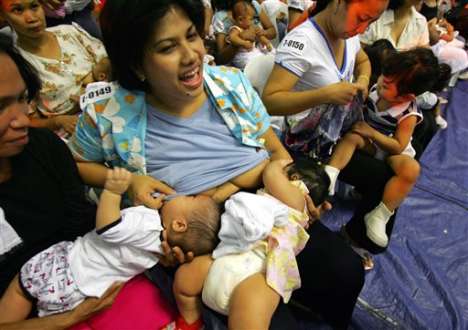
I think breastfeeding is a beautiful and natural process that goes in and out of fashion our so-called civilized countries.  Our bodies are naturally made to do so, and research has proven time and time again all of the wonderful benefits.  So it is baffling that new mothers have to fight most employers for a place to pump their breast milk for their babies.  I plan to advocate for any nursing mother’s right to publicly and have a clean safe place in the work area to breastfeed and/or pump.

In a blog titled Breastfeeding in Utah, a post spoke about the following:
"Some Texas mothers demonstrated resistance outside of a Texas mall where a security guard told her to cover herself up when she was breastfeeding.  These peaceful protests can also be referred to as “nurse-ins”.  Another example is a woman who organized a “feed-in” at a local mall in which more than 160 woman participated in."

I found an awesome site dedicated to controversial topics about women’s breast called 007 Breasts.  One topic found at http://www.007b.com/public-breastfeeding-world.php allows women to post about breastfeeding in public in their part of the world.  The following posts have been retrieved from the link above:
Kenya
In my country, breastfeeding is normal. In fact, a woman who doesn't breastfeed is frowned upon. The only women who don't breastfeed are usually under strict doctors orders.
Breastfeeding in public is normal. I have been raised around this and seen many women whip out a boob in public without a cover up and no one gives a second thought to it. Breasts, especially of a nursing mother, are not regarded as sexual. My entire family has been nursed. I was breastfed by mother till I was 2 years old and my aunt breastfed her baby till she was one year old.
Sharon
Egypt
Egyptian women can't try beastfeeding in public because of our habits, and beside this, it's forbidden as our religion tells us.
Ahmed Moustafa
Ghana
Ghanaians see breastfeeding the surest and purest way to nurse a baby. Wherever you are, no matter what u are doing, you are expected to feed your baby if the need arises. If you dont and the baby keeps crying you end up with heaps of insults from onlookers and you are suspected of stealing the baby. The culture in Ghana frowns on exposing the body in public even the cleavage, but then exposing the breast for baby feeding purposes is highly encouraged.
adwoa
Israel
Breastfeeding in Israel is accepted and is promoted (La Leche is very active) but unfortunately many women wean when they go back to work (which is often after three months) and switch to formula (sometimes with very sad consequences; a while ago there was a scandal with a formula called Remedia whose composition got changed by mistake and it lacked Vitamin B1. Some babies died and some infants sustained profound neurological damage. It was a very big scandal). Judging from the women I know and the WHO only few women nurse past 6 months and formula is big business there and very affordable.
Patricia
Pakistan
Mothers prefer breast feeding in Pakistan. In rural areas mothers don't mind breast feeding at any place. In cities mothers take care for any indecency but they are not worried to feed at any public place. Particularly women avoid feeding in front of their relatives. Although many times it has seen women not minding open their breasts and nipple show.
Najma
Hong Kong
Breastfeeding in Hong Kong is regarded as very rude and is indecent exposure in public. I have never seen a Hong Kong woman breastfeed their child in public. If mothers want to breastfeed their child, they either do it at home (and bring out bottled milk) or in the washroom cubicles. Once in an immigration office, a mainland Chinese woman was breastfeeding. She wasn't stared at, but the people who accidentally glanced all walked away, and started badmouthing the mainland China woman.
E
Australia
Australia now has 100% legal protection for mothers who breastfeed in public. Every State and Territory has now specifically protected the rights of women to breastfeed in public. The legislation in most states also includes breastfeeding as one of the grounds for unlawful discrimination in other areas such as employment.

On 24 May 2011, the Australia Federal Parliament also passed changes to the Sex Discrimination Act to make breastfeeding a separate, stand-alone ground of discrimination, rather than a subset of sex discrimination.

It's a sad reflection on society that we need to do this, but good that we have.
Ros